One of the first questions people ask themselves when they start getting serious about photography is if they need filters or not. The simple answer is ‘no’. The complex answer is ‘yes, if you want to take your pictures to the next level.’ The next question is usually ‘alright, which ones are right for me?’ Everyone’s needs vary based on their individual type and style of photography. Below I will do my best to tell you about my filters, and when and why I use them.
UV Filters
There’s probably more debate over the use of UV filters than any other filter. Proponents will tell you that it cuts haze and that it protects the outer element from getting scratches on it. They’ll also tell you that it may help protect the lens during a fall. Opponents will tell you that using the UV filter degrades the optical quality and doesn’t really cut haze as advertised.
Personally, I have a foot in both camps. I agree with the opponents that I see no noticeable difference in the haze. I agree with the opponents that UV filters can degrade the optical quality, if you purchase cheap filters. However, if you stick with B+W or Rodenstock, then there really shouldn’t be any degradation in optical quality. Beware of lesser brands such as Lee and Cokin though! Perhaps the most important thing I agree with is that the filters can protect the front element from wear and tear and that they can protect your lens if your camera should ever get dropped.
A friend of mine was kind enough to demonstrate for us why a UV filter may some day be your best friend.
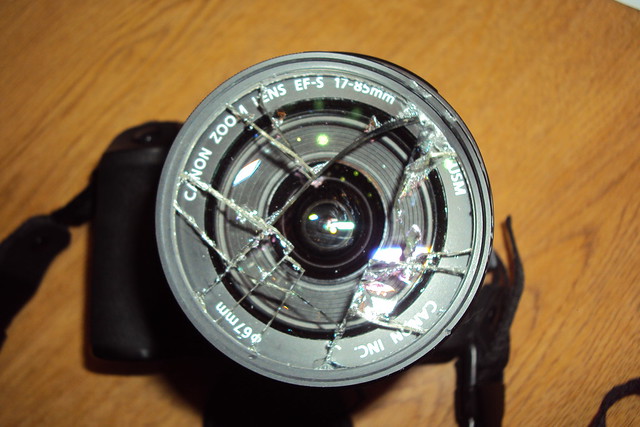
The filter went up to the great big optic factory in the sky, but the lens survived to shoot another day.
It’s worth noting too that some lenses are only considered weather sealed when a filter is on the end, such as the Canon EF 16-35mm f/2.8 L II USM lens. Usually this applies to lenses that have a front element that moves during focusing. Check your owner’s manual for your lens’ specifications.
I have UV filters on every lens I own, which are all B+W, with the exception of one Rodenstock.
Polarizing Filters
The technical explanation of what a polarizing filter does is very scientific. I will try and break it down into something that is easier to understand.
In simplest terms, a polarizing filter reduces or eliminates glare and reflections from non-metallic surfaces and enhances colours. There’s an excellent Wikipedia article with several examples of how polarization helps photography. Perhaps the best example I’ve ever seen was taken by Christine Grabig.

A lot of detail and color is pulled back into the sky and the rock face. The dark blue is another one of the byproducts of using a polarizing filter.
There are two types of polarizing filters: linear and circular.
Those of you that know me well know that I prefer shooting around sunset or at night. I enjoy shooting at sunrise as well, but I haven’t seen one of those for a long long time. Whenever I have to shoot in the harsh sunlight of the day, I always have a B+W circular polarizing filter on the end of my lens.
Until recently, it never occurred to me that there was anything other than neutral polarizing filters. However, superstar-photographer Jon Cornforth was kind enough to share with me some of the tools he considers mandatory for getting his amazing shots. One of these tools is a warming polarizing filter. Singh-Ray makes one that I am now licking my chops over. The warming polarizing filter would be a great addition to the collection of anyone who shoots a lot of sunsets and sunrises.
Neutral Density Filters
Neutral Density filters, or ND for short, are filters that simply permit less light from reaching the sensor. The most common use for these filters is to allow the shutter to stay open longer to catch motion, while still maintaining proper exposure. The smooth and silky water effects that are often seen on photographs of waterfalls are typically the result of using an ND filter.

The waterfall image above was taken with a B+W screw-in ND 1.8 (six stops of light). The reduction of light hitting the sensor allowed me to leave the shutter open for 15 seconds in the middle of the day. Without the filter, the time I could have kept the shutter open and gotten the same exposure would have been much less and the water wouldn’t have had the silky smooth effect that is apparently very desirable to many.
Graduated Neutral Density Filters
Graduated Neutral Density filters, or GND for short, are primarily used increasing the dynamic range in a photograph. There are GNDs for many different shooting scenarios: soft GND, hard GND, reverse GND, one stop, two stop, etc, etc. The list goes on and on.
The right hand side of the image below is an excellent example of how the detail and color in the sky have been kept intact, while maintaining proper exposure throughout the entire image. On the left hand side, only the lower half of the image is properly exposed and the color has all but disappeared in the sky. There’s also highly-undesirable blown out highlights.

This shot was taken using a 3-stop soft GND and a 3-stop hard GND stacked.
I hope after reading this, you have a better understanding of filters and how they can enhance your photography. In the near future, I will write a follow-up post to this one better explaining the difference between GND filters.